
One year · one flat · three people · 1.855,98 € a month
The end of household
debt diplomacy.
This is the story of Lukas, Sarah, and Anja at Wrangelstraße 43 — and the app that split their rent, their groceries, and one very contested cent, so they never had to negotiate. Scroll through their year.
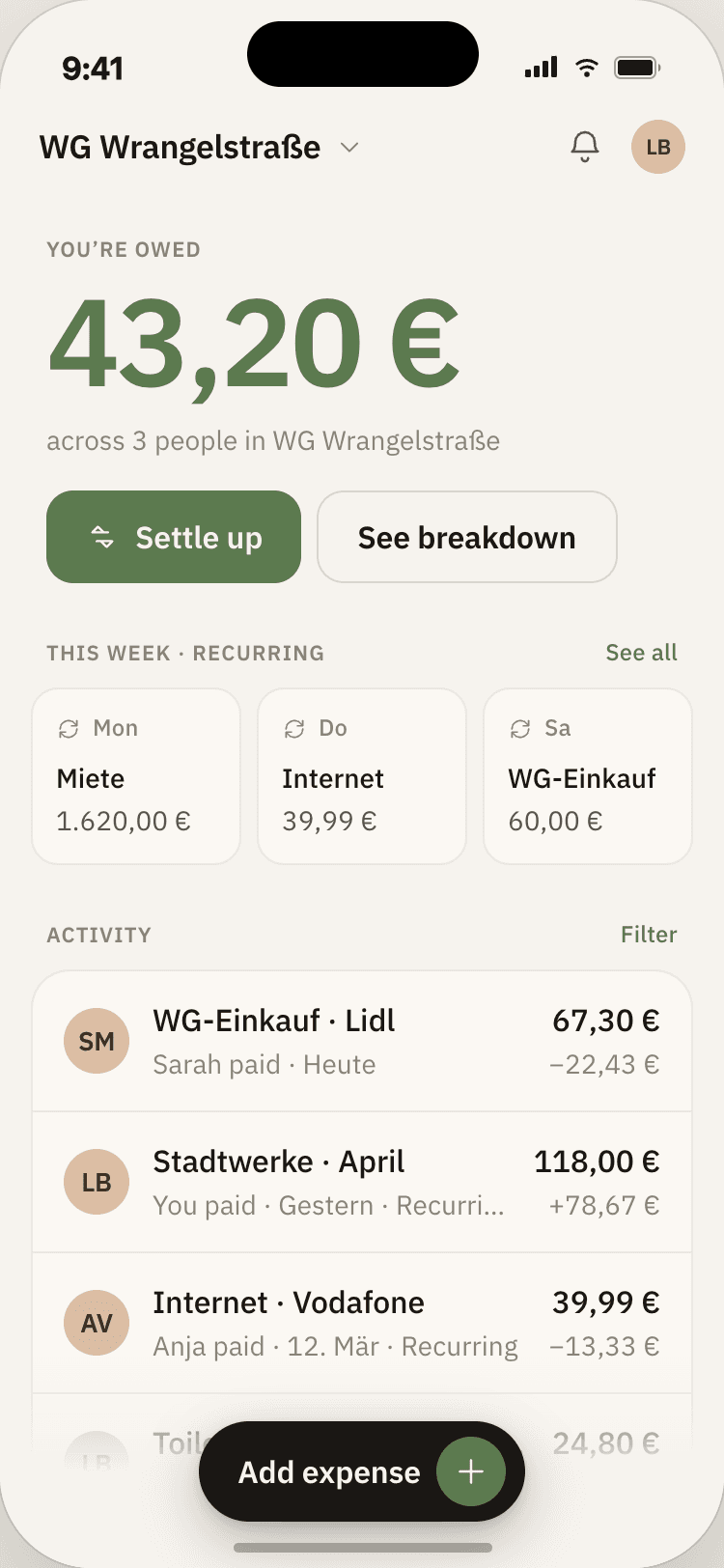
October — move-in day
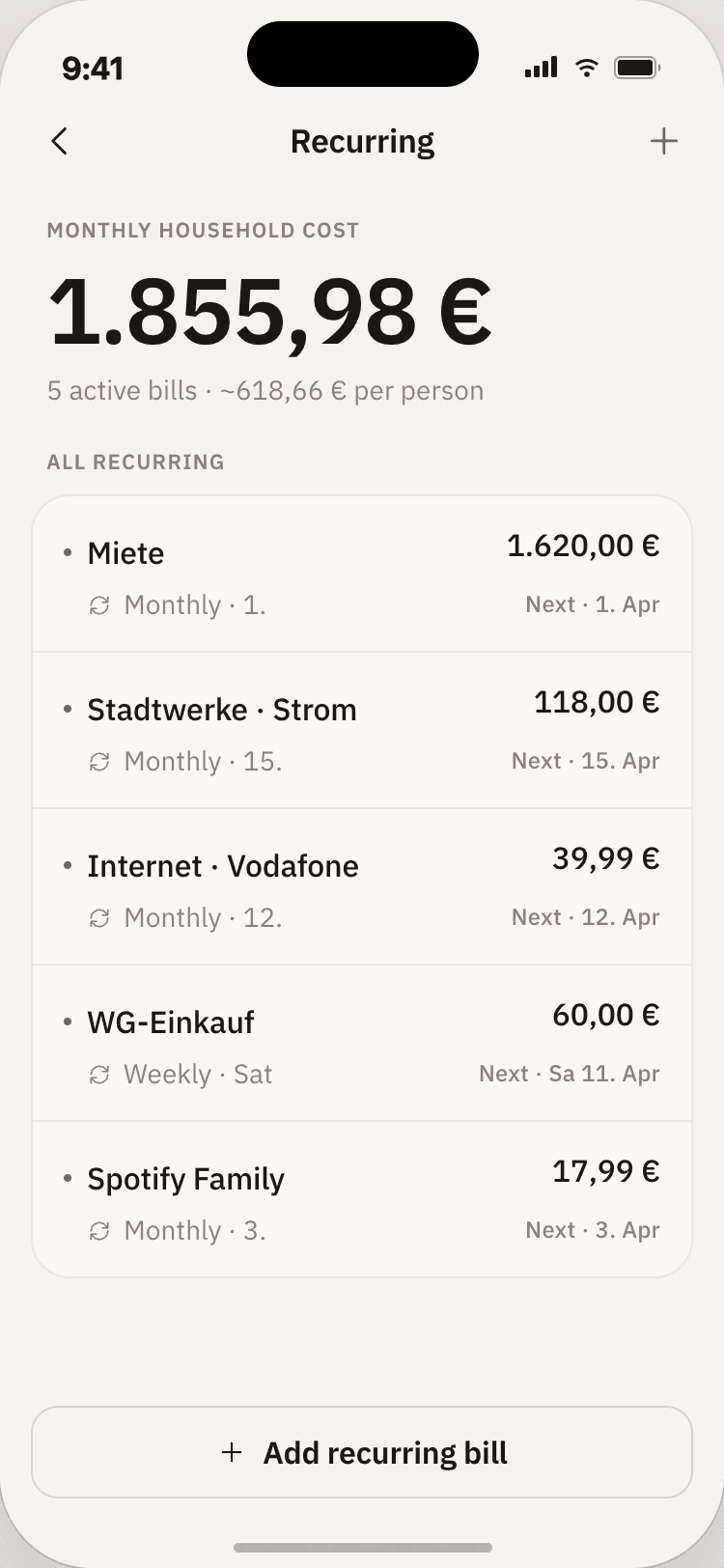
Boxes, keys, and 1.855,98 €.
Three names on a Kreuzberg lease. The furniture is borrowed, the Wi-Fi has a name nobody will admit to, and the first rent is due before the boxes are open.
Lukas types the rent into Hearth once. That is the last time anyone types it.
→ 618,66 € each, on the 1st, every month, split before anyone wakes up. Utilities and internet follow the same rule.
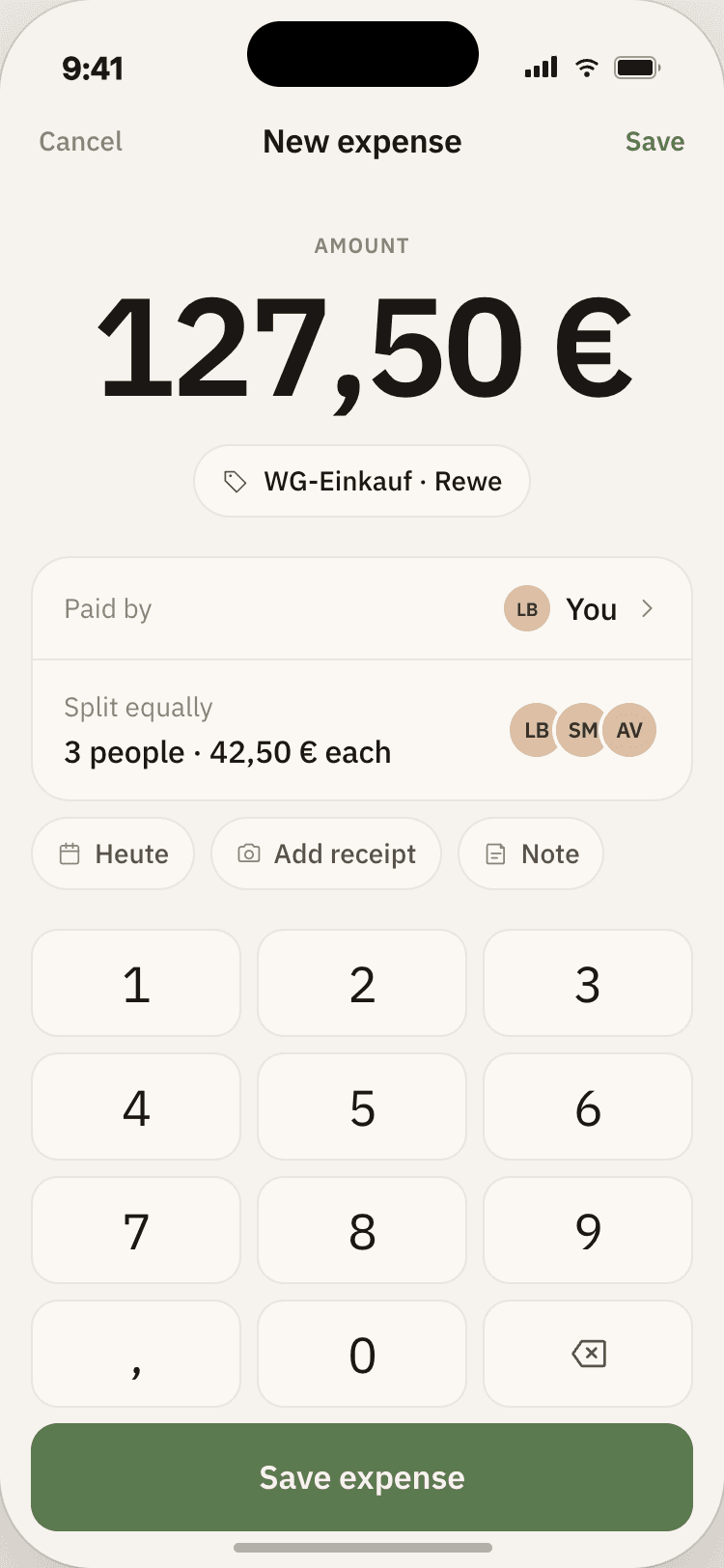
December — the oat-milk ledger
Small debts are the loud ones.
Nobody fights about rent. They fight about the 127,50 € Rewe run Lukas covered, the Pfand Anja returned, the oat milk that is somehow always gone. Every household keeps this ledger — usually in three heads, three differently.
Hearth keeps it in one place instead: every expense lands in the same feed, and everything compresses into one number per person.
December — still counting
the number everyone trusts
Not nine IOUs. Not a spreadsheet. One balance.
- Rewe runLukas127,50 €
- InternetSarah39,99 €
- Pfand returnAnja−9,25 €
- DrogerieSarah23,80 €
- Pizza nightLukas31,60 €
- Strom (Stadtwerke)auto86,20 €
- Oat milk × 6Anja13,74 €
- Spotify Familyauto14,99 €
January — U8, six stops underground
No bars. Full ledger.
Sarah buys döner for everyone at Kottbusser Tor and logs it somewhere between Moritzplatz and Hermannplatz, forty meters under Berlin, with zero bars of signal.
Hearth is offline-first: the ledger lives on the phone, not on someone else’s server. It syncs when she surfaces. Dead zones, basements, flights, network outages — the household’s money never waits for a connection.
(It also never shows an ad down there. Or anywhere.)
March — dinner, three ways
67,30 € ÷ 3
does not divide. Somebody gets the extra cent. In most flats, that is a negotiation. In Hearth, it is a rule.
Deterministic to the cent: the same split always gives the same answer, so nobody rounds in their own favor. Next dinner, the cent moves on. Fair is a rule, not a mood.
May — spring cleaning
A month of favours, two transfers.
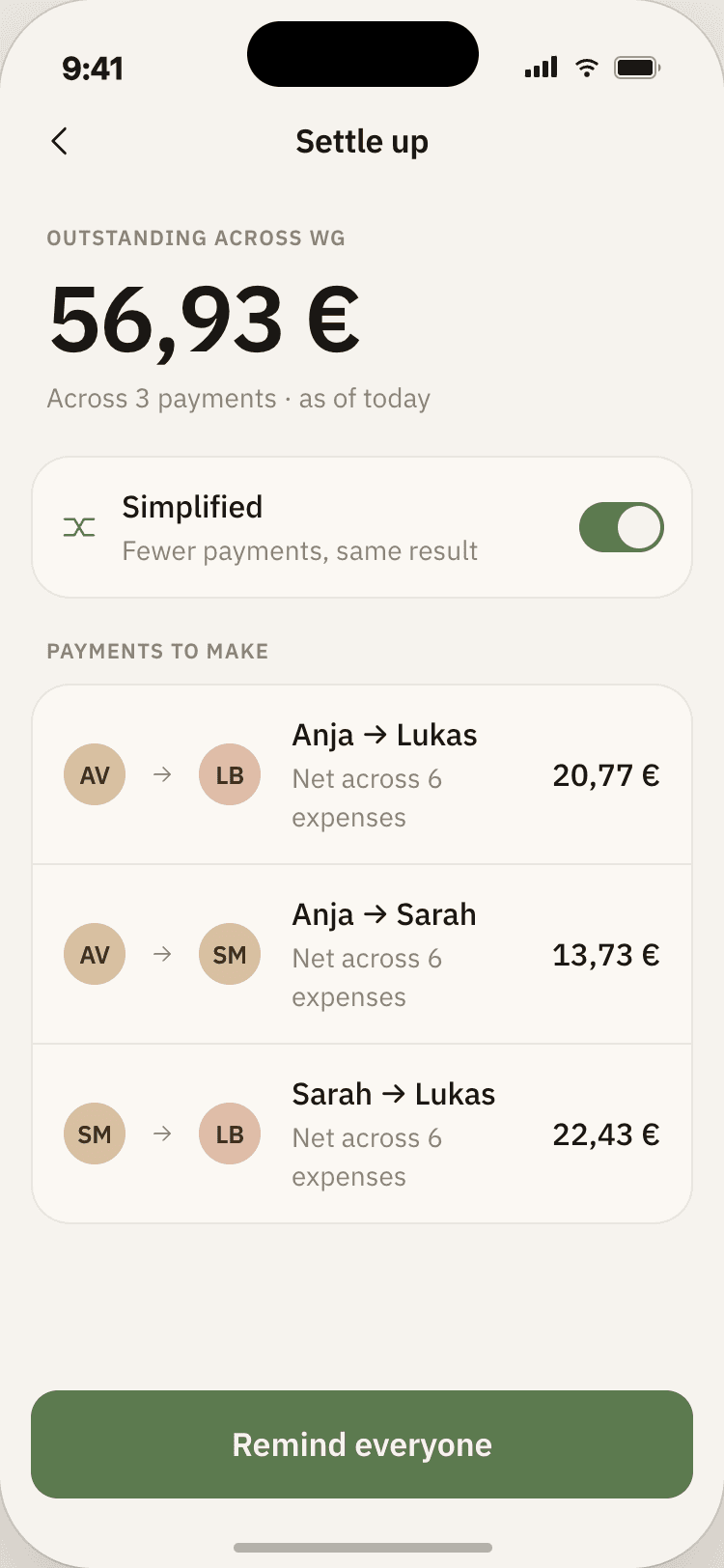
By May the ledger holds a winter of groceries, one broken shower rod, and 62 shared expenses. Settling it by hand would be nine payments and one very long evening.
Hearth nets everything into the fewest possible transfers: Anja pays Lukas 20,77 €, Sarah pays Lukas 22,43 €, done. One tap, and the board wipes clean.
Nobody owes anybody. The whole point.
September — the hard chapter
Anja gets the job
in Hamburg.
This is where shared households actually break: not over rent, but over the leaving. The deposit, the half-used Putzmittel, eleven months of “I’ll get you back” — all due at once, usually as an argument.
Hearth reconciles everything Anja owes and is owed, across every bill and grocery run since October, into one fair final settlement on the day she hands back the key.
No other expense app has a move-out. This one was built for it.
She leaves as she arrived: even.
Epilogue for the skeptics
Why this isn’t a trip splitter.
Trip splitters are built for groups that dissolve. A household never dissolves — which is why Hearth is a genuine Splitwise alternative for households, not another holiday tool.
| Living together means… | Trip splitters | Hearth |
|---|---|---|
| Rent & utilities every month | Re-typed by hand, or premium-only | Recurring, first-class, included |
| Logging daily expenses | Free tiers cap entries per day | No limits, ever |
| Your ledger’s attention | Ads, upsells, locked features | No ads — 1 $/person is the model |
| Basement, U-Bahn, dead spots | Online-first, offline as afterthought | Offline-first by architecture |
| A roommate moves out | Manual math and a group-chat fight | One fair final settlement |
Small print, before you join
Questions, answered.
How much does Hearth cost?
The first 14 days are free, then Hearth is 1 dollar per person in the household per month. Every feature is included, there are no ads and no daily limits. The price is the whole business model, so your ledger is never the product.
Does Hearth work offline?
Yes. Hearth is offline-first: your household ledger lives on your device, so you can add expenses with no signal, in the basement or on the U-Bahn, and everything syncs when you are back online.
Is Hearth a good Splitwise alternative for households?
Hearth is built specifically for people who live together rather than for trips. Recurring bills like rent and utilities split themselves every month, there are no daily entry limits, no ads, and when a roommate moves out Hearth produces one fair final settlement.
How does Hearth split rent and bills?
Split equally, by shares, or by exact amounts. When an amount does not divide evenly, Hearth distributes the leftover cents deterministically, so 67.30 across three people is always 22.43, 22.43, and 22.44.
What happens when a roommate moves out?
Hearth reconciles everything the departing person owes and is owed, across every bill and expense, into one fair final settlement. Move-out day stops being an argument about money.
Does Hearth work for couples?
Yes. Hearth works for any shared household: roommates, flatshares, couples, and families. There is no bank linking, so you share expenses without sharing accounts.
When does Hearth launch?
Hearth is in the final stretch before release on the App Store and Google Play. Leave your email and we will send exactly one message on launch day.
Your chapter
Their year is over.
Yours is starting.
Hearth is in the final stretch before launch on the App Store and Google Play. One field, one promise: a single email on launch day. Nothing else, ever.
14 days free, then 1 $ per person in your household, per month. Split it like everything else.